Showing posts with label Gospel. Show all posts

Thursday, February 19, 2009

Is It Okay to Doubt Your Salvation?

Yesterday, I brought a quote from Will Metzger's Tell the Truth about false assurances of salvation. Today, I want to encourage those who are struggling in their hope of salvation. Metzger goes on to talk about these individuals who think they may have a personal relationship with God, but struggle with assurance of this knowledge. How can they know that they are secure in Christ?
"Again, the kind thing is to bring the sure Word of God, with its infallible promises, alongside the grace they find exists in their changed hearts. The Spirit will then enable believers to say with assurance, 'I am a child of God and will be forever' This great comfort and encouragement does not come through a private revelation of the Spirit (a witness of the Spirit apart from or in addition to the Bible). Assurance is effected not by imparting new revelation to a person's heart, but by applying what is already revealed in Scripture, namely, the truth that believers shall be saved." (p81)
What is Metzger saying? I have been told many times in life that after you "lead someone to the Lord", the next thing you absolutely must do is "give them assurance of their salvation." So you underscore to them that when they begin to doubt this salvation, they should remember that they asked Jesus to save them at this point in time. The eye-opening thing (at least for me) is that Metzger is saying that assurance is not our job.


Metzger goes on to point out that God wants us to be examining our lives to make sure of our calling. "He makes us restless, even to the point of questioning our salvation, so that we may not presume on his favor, but instead, relish his grace." Any confidence we have should be based on the finished work of Christ alone as revealed to us in the Word of God alone. The Bible makes it clear, though, that a result of doing that (placing confidence in the Gospel on a daily basis), will result in a changed life--specifically, patterns of sin in our life will be broken.

"Our eternal security should be focused not on remote past actions but on our present attitude toward Christ. Just as earthly parents can expect physical growth in their children, so we can expect to see a gradual change in the lives of God's children." (p81)


Wednesday, February 18, 2009

Is It Good to Shatter People's Hope of Salvation?

UPDATE: I added page # references to the end of these quotes.

Hear this difficult, but necessary word from Will Metzger in his book, Tell The Truth:
Is it kind to shatter a person's hope of salvation? Yes, because without scriptural grounds, it is nothing more than a false hope. A hope of acceptance by God based on such things as going forward in a meeting, praying a suggested prayer, imitating the experience of others, joining a church, attending many Christian meetings, being baptized, studying the Bible regularly, helping others, [being confirmed,] feeling good in a religious service or having a strong conviction that they are right with God is a hope not founded on biblical truths. Perhaps people may trust in the doctrine of election or in theological precision or baptism. They may have a sentimental belief in the general providence of God: "God has been good to me; God will take care of me." Yet people can be involved in any or all of these activities without ever looking to Jesus Christ as the only Savior and Lord. Without this there is no salvation. Without this there is no assurance. Let us in kindness alert these people to what Christ will say to them on the day of judgment. "Not everyone who says to me, 'Lord, Lord,' will enter the kingdom of heaven, but only he who does the will of my Father who is in heaven. Many will say to me on that day, 'Lord, Lord, did we not prophesy in your name, and in your name drive out demons and perform many miracles?" Then I will tell them plainly, 'I never knew you. Away from me, you evildoers!' (p80-81)" (Matthew 7:21-23)"

Metzger says there are two questions: How do you become a Christian? and How do we know if we are a Christian? The first is answered by, "You become a Christian through repentance toward God and faith in Christ alone as Savior and Lord." The second is answered by looking at your life for these results:

"The first pillar of assurance is a trust in the promises of God as being promises to you. You count them true and take them personally. The second is the beginning of a change in your attitudes and actions corresponding to the fruit of the Spirit (Galatians 5) and the marks of salvation (1 John). The third is the inner witness of God's Spirit to your spirit that you are his child (Romans 8)." (p79)

Thursday, February 12, 2009

A Letter From Andrew

(This was read at his funeral yesterday)

A letter from Andrew to be read after his passing:

A brisk fall afternoon, the bright red and yellow leaves are falling from the trees at Round Lake Park, the sun is shining. I can feel the cool fresh air entering my lungs with every breath. I smell garlic and homemade Italian food in the wind. For you maybe it's a spring day and the flowers are blooming, or it's Christmas and the snow is falling and you are sitting with a warm mug of coffee by the fire. It's at those seemingly perfect moments that you know this all didn't happen by chance. It is not by chance that the leaves turn red in the fall, and it is not by chance that I'm not standing here reading this letter to you now.

After all the suffering I have seen thus far, there are only two things that I know are true. That I love my wife and kids so much, and that God loves me infinitely more than that. Thank you, thank you, thank you, to all who have loved, served, and prayed for us. I am so very sorry to leave you all behind, but at the same time I am so happy to be home with my maker. Everything that I love about the fall and the leaves and the fresh air and Italian cooking in the wind, pales in comparison with what it is like in the presence of Jesus. I have not eaten in a very long time, but know that I hunger no more. There is no more pain or suffering, no more tears or sorrow. Grace, AJ, and Gracie, know that God holds you in the palm of His hand especiallly now. Jesus will lead, guide, and protect you. I am confident that your mourning will turn to dancing.

Fight for joy in this. Rejoice because cancer can kill my body but it cannot kill my soul. Rejoice because my greatest sickness was cured in 2001 at the age of 20 when I believed that Jesus could forgive such great sins as mine. Rejoice because even through sickness and death God has done great things in my life, and yours. Rejoice because this is not the end, it is just the beginning.

Rejoice! Again I say rejoice!

I will see many of you soon.

Andrew W. Mark

(Hat tip to Kim)

Tuesday, February 03, 2009

How Should Apologetics Be Used in Evangelism?

Apologetics' effectiveness in evangelism efforts is to bring people to a place where the intellectual questions are answered and put aside so that the moral choice to submit to God and believe the Gospel or not is on the table. No human argument will ever be persuasive enough to induce a true submission to God.

Tuesday, August 05, 2008

How Much Did Christ Endure On the Cross?

As I was thinking this morning about the Gospel while reading A Gospel Primer for Christians, I began thinking about the wrath of Christ endured on the cross. I deserve the wrath of God put on me for all my sin: every sin I've ever committed, every sin I'll commit today, and every sin I'll commit in the future. However, because of the faith that God put in me to hope in Christ alone, I have been justified by grace alone: Every single one of those sins have received their just penalty. I cannot mess up my position before God by wallowing around in the mud of sin today because He has already punished me for all those sins vicariously through Jesus Christ, my Proxy. The verdict that will be rendered to me on judgment day is innocent—the penalty (a blood sacrifice of infinite worth) has been paid for me.

Now here's the thought that sunk in pretty well this morning: The atonement on the cross covered all my sins and sealed my pardon on judgment day—in other words, my forgiveness was actually (for theologians, I realize that's where the rub is: actual versus potential, but I don't think that potential atonement has any ground to stand on Biblically) accomplished on the cross. Given that proposition, we have only two options in understanding who Jesus died for on the cross: If we say that Jesus died for every single human being, then we have to say that since Christ accomplished my forgiveness on the cross, then He accomplished forgiveness for everyone on the cross. If that's true, then on judgment day, everyone will be given a release pardon. Now if you think you can get a universal pardon out of texts like Revelation 20:15 then by all means, go ahead and believe that! (But personally I think you'd have to be smoking something illegal to get that kind of interpretation! J) Or, our only other logical option will be that Christ accomplished forgiveness for all those whom God predestined to be conformed to the image of His Son.

To put it simply:

Christ's work on the cross releases someone from their just penalty.
All will benefit from Christ's work on the cross.
Therefore, all will be released from their just penalty.

OR

Christ's work on the cross releases someone from their just penalty.
Only a certain number will benefit from Christ's work on the cross.
Therefore, only a certain number will be released from their just penalty.

If you're a little perturbed by this (that's a normal feeling!), you may be thinking, "That doesn't seem right, Paul. I don't agree with either of those." Here is likely what you believe then:

Christ's work on the cross made it possible for someone to be released from their just penalty.
Only a certain number will benefit from what was made possible for them on the cross.
Therefore, only a certain number will be released from their just penalty.

You wouldn't be heretical for thinking this. It's actually what most people I grew up with believe. For them, the "made possible" part is changed to "actualizes" once a person puts their faith in Christ. However, I cannot stand by that argument because of texts like Acts 20:28 where Paul says to the elders at Ephesus as he was leaving Miletus, "Pay careful attention to yourselves and to all the flock, in which the Holy Spirit has made you overseers, to care for the church of God, which he obtained with his own blood" The work of Christ actually obtained for Him the Church of God through the shedding of His blood. He actually paid the price.

This brings such comfort to my soul because it helps me know that my justification is not a once-in-the-past event. My justification is a past-now-and-future event that is as sure as God's promises. That means that I can never ever step out of God's favor. God will never be angry (in a wrathful disposition towards me) with me because He already poured out His wrath upon me via my Proxy. It does not mean that God is not saddened, deeply, when I sin. But it does mean that He will always look on me with lovingkindness because He will always look on His Son with lovingkindness since I died with Christ and have been resurrected with Him to walk in newness of life! Rejoice in your salvation!

Text not available
The everlasting righteousness By Horatius Bonar

Tuesday, July 29, 2008

The Gospel. Not the ABC's of Getting Saved.

Tim Keller, a pastor at Redeemer Presbyterian Church, has written a very helpful article/study called "The Centrality of the Gospel." In this article, he helps you think out the practical ramifications of the Gospel to so many areas of life. He begins, though, by showing how the Gospel is not just the ABC's of getting "saved":
In Galatians 2:14, Paul lays down a powerful principle. He deals with Peter’s racial pride and cowardice by declaring that he was not living “in line with the truth of the gospel”. From this we see that the Christian life is a process of renewing every dimension of our life-- spiritual, psychological, corporate, social--by thinking, hoping, and living out the “lines” or ramifications of the gospel. The gospel is to be applied to every area of thinking, feeling, relating, working, and behaving. The implications and applications of Galatians 2:14 are vast. ...

First, Paul is showing us that that bringing the gospel truth to bear on every area of life is the way to be changed by the power of God. The gospel is described in the Bible in the most astounding terms. Angels long to look into it all the time. (I Peter 1:12). It does not simply bring us power, but it is the power of God itself, for Paul says "I am not ashamed of the gospel, for it is the power of God for salvation" (Rom.1:16).

Second, Paul is showing that we never “get beyond the gospel” in our Christian life to something more “advanced”. The gospel is not the first “step” in a “stairway” of truths, rather, it is more like the “hub” in a “wheel” of truth. The gospel is not just the A-B-C’s but the A to Z of Christianity. The gospel is not just the minimum required doctrine necessary to enter the kingdom, but the way we make all progress in the kingdom.

We are not justified by the gospel and then sanctified by obedience, but the gospel is the way we grow (Gal.3:1-3) and are renewed (Col.1:6). It is the solution to each problem, the key to each closed door, the power through every barrier (Rom.1:16-17). It is very common in the church to think as follows. "The gospel is for non-Christians. One needs it to be saved. But once saved, you grow through hard work and obedience." But Col.1:6 shows that this is a mistake. Both confession and "hard work" that is not arising from and "in line" with the gospel will not sanctify you--it will strangle you. All our problems come from a failure to apply the gospel. Thus when Paul left the Ephesians he committed them "to the word of his grace, which can build you up" (Acts 20:32)

The main problem, then, in the Christian life is that we have not thought out the deep implications of the gospel, we have not “used” the gospel in and on all parts of our life. Richard Lovelace says that most people’s problems are just a failure to be oriented to the gospel--a failure to grasp and believe it through and through.


From The Valley of Vision, "The Gospel Way" (p62):
Glorious Trinity, impress the gospel on my soul,
   until its virtue diffuses every faculty;
Let it be heard, acknowledged, professed, felt.
...
Take me to the cross to seek glory from its infamy;
Strip me of every pleasing pretence of righteousness by my own doings.

Tuesday, July 22, 2008

Scoliosis and the Gospel Pt.5

Savannah has to wear this brace for 23 hours per day. It's a nuisance in the sense that it seems so uncomfortable and because of its inconvenience. Yet, we would be wrong to let Savannah have her way and not wear it. This brace should prevent the curve from getting worse and further, may, and already has, help correct the curve. We didn't see this coming though.

We knew Savannah was growing up like a weed, fast and tall, but it wasn't until someone outside of our family--our family doctor--examined her and pointed out what was so obvious to her: She has a crooked back. Even once we found out about the crooked back, there was nothing we, in and of ourselves, could do to stop the crookedness. Having a crooked back doesn't automatically correct itself. You don't wake up one morning with a curve in your spine and then another morning later, months down the road, wake up and find the curve is gone. We needed someone else who was much more capable of fixing the problem step in and address the issue. We needed a brace.

But purchasing a brace and having it custom-fitted to Savannah was not enough to fix her back. Accepting the brace into her life as something she owned was not enough. Everyday, every hour (of course with a few exceptions--baths, swimming, sports, etc--but hey, work with me on this!) she has to keep the brace on her. Her act of simply putting the brace on though, is not what fixes her back. The brace itself is what fixes her back.

It's an analogy and all analogies break down, but I think you can see the picture pretty clear (at least I hope so, otherwise, I'm praying that God will give you eyes to see and ears to understand):
1 Corinthians 15:1-2 Now I would remind you, brothers, of the gospel I preached to you, which you received, in which you stand, and by which you are being saved, if you hold fast to the word I preached to you- unless you believed in vain.

We need a Savior. He is the One who picks us up from our state of deadness, changes our hearts of stone to hearts of flesh, places within us faith to believe, and causes us to repent and believe continually until the end. Dear friends, "continue in the faith, stable and steadfast, not shifting from the hope of the gospel that you heard..." (Colossians 1:23)

Read about Savannah's Scoliosis
Scoliosis and the Gospel Pt. 1
Scoliosis and the Gospel Pt. 2
Scoliosis and the Gospel Pt. 3
Scoliosis and the Gospel Pt. 4

Saturday, July 12, 2008

Scoliosis and the Gospel Pt.4

Yesterday, I mentioned in passing that one of the ramifications of scoliosis is social stigma. The researchers tend to gloss over this saying there isn’t any real danger to the patient’s health, yet there is a real issue here that must be faced: "As for the cosmetic concerns, the researchers state that the untreated people 'can develop significant deformity, and the cosmetic aspect cannot be disregarded.'" (Ref) In the article from the University of Maryland Medical Center, the real impact on the whole person is brought out: "The emotional impact of scoliosis, particularly on young girls or boys during their most vulnerable years, should not be underestimated. Adults who have had scoliosis and its treatments often recall significant social isolation and physical pain." The bottom line is—scoliosis can result in incredible shame and ridicule. And the Gospel speaks to this. Dramatically.

Hannah knew about shame—she was unable to have children and in those days that was the ultimate shame for a woman. 1 Samuel 1:6-7 said, “And her rival used to provoke her grievously to irritate her, because the Lord had closed her womb. So it went on year by year. As often as she went up to the house of the Lord, she used to provoke her. Therefore Hannah wept and would not eat.” Then God rescued her from her shame and brought her a son.

Hannah’s deliverance is such a beautiful picture of what God does for us through the Atonement. There are two kinds of shame: the shame from being sinned against and the shame that comes from sinning. Christ became a man and fully realized what it meant to be shamed—sinned against. (Hebrews 2:14-18) But then He also took on all of our sin-shame and bore that in His body on the Cross. He who knew no shame because of sin became shameful for us that we might become the righteousness of God. (2 Cor 5:21)

We’ve talked with Savannah much about this and she realizes that when she’s made fun of about the brace to remind herself that Christ experienced the shame of being sinned against. But more importantly, though we are sinned against, our biggest problem is that we have sinned against God.

The emotional pain that comes from being made fun of should never be dismissed. There is much comfort knowing that in the end He will right every wrong that has ever been done to us. But there is even more comfort in knowing that if we are covered by the blood of Jesus Christ, every wrong we’ve ever committed against Him has already been punished and hence, forgiven.

Read about Savannah's Scoliosis
Scoliosis and the Gospel Pt. 1
Scoliosis and the Gospel Pt. 2
Scoliosis and the Gospel Pt. 3
Scoliosis and the Gospel Pt. 5

Friday, July 11, 2008

Scoliosis and the Gospel Pt.3

What can happen if scoliosis is left untreated? According to the University of Maryland Medical Center, with...
Severe Scoliosis (over 70 degrees). If the curvature exceeds 70 degrees, the severe twisting of the spine that occurs in structural scoliosis can cause the ribs to press against the lungs, restrict breathing, and reduce oxygen levels. The distortions may also affect the heart and possibly cause dangerous changes.

And with...
Very Severe Scoliosis (Over 100 degrees). Eventually, if the curve reaches over 100 degrees, both the lungs and heart can be injured. Patients with this degree of severity are susceptible to lung infections and pneumonia. Curves greater than 100 degrees increase mortality rates, but this problem is very uncommon in America.

So in general, with more severe cases, scoliosis left untreated can be very dangerous. However most people with scoliosis simply experience back pain and social stigma (more on that tomorrow). For most, it comes down to a "quality of life" issue.

But what about sin? What happens if we leave sin "untreated"?
Romans 6:23 For the wages of sin is death, but the free gift of God is eternal life in Christ Jesus our Lord.

In our world, we tend to think, I'm okay with a little sin in my life but God has something else to say about that...

Read about Savannah's Scoliosis
Scoliosis and the Gospel Pt. 1
Scoliosis and the Gospel Pt. 2
Scoliosis and the Gospel Pt. 4
Scoliosis and the Gospel Pt. 5

Thursday, July 10, 2008

Scoliosis and the Gospel Pt.2

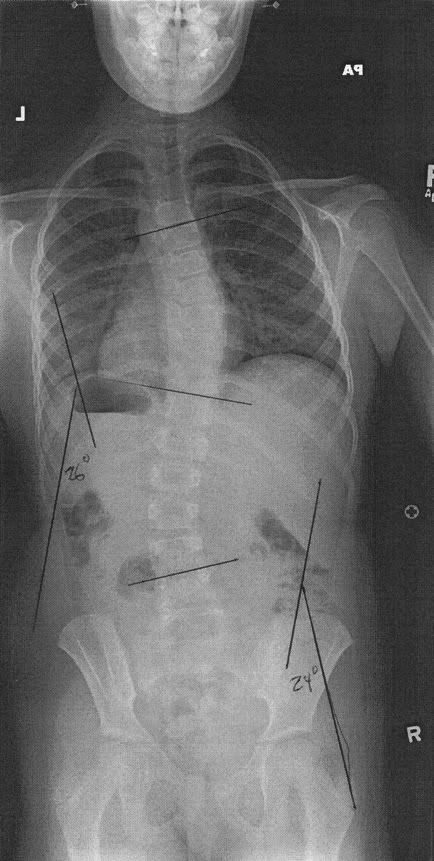
In order to be considered as scoliosis, the spine must have a curve on the xray at least greater than 10°. That's according to the Orthopaedic Surgery department at Massachusetts General Hospital. Our doctors have told us that once the curve is around 24 degrees or greater they start looking at what needs to be done about it. However, in the case of children growing very quickly, they will sometimes be proactive and introduce the brace earlier than that. Savannah's s-curve is 26° and her c-curve is 24° as you can see in her xray on the left. At the rate of her growth and with that degree of curvature, they were concerned enough that we should introduce the brace.

But for others, if the curve is less than 20° and the individual is done growing, the scoliosis can be left untreated. ...So being a little crooked is okay. That brings me to the second way that we as a family have observed that the Gospel applies to scoliosis: How crooked are we as humans and how crooked can we be and still be considered "ok"?

How Crooked Are We?

Psalm 14:1-3 tells us clearly how crooked we are as humans:
The fool says in his heart, "There is no God." They are corrupt, they do abominable deeds, there is none who does good. The LORD looks down from heaven on the children of man, to see if there are any who understand, who seek after God. They have all turned aside; together they have become corrupt; there is none who does good, not even one.

We're not just people who do bad things occasionally--we're thoroughly sinful people. In and of ourselves we will not do anything good that pleases God. Even the charitable actions we see of people in the midst of crises are acts enabled by the common grace that God gives to both the believer and unbeliever. In fact, we are so crooked, we are outright rebels. As C.S. Lewis put it, "Fallen man is not simply an imperfect creature who needs improvement: he is a rebel who must lay down his arms."[1]

How Crooked Can We Be?

But even knowing that we are crooked people, we tend to think, "Well, I'm not as crooked as so-and-so. I mean look at him: he sleeps around on his wife." But that misses the point of how depraved we truly are. When the Bible says that the heart is desperately wicked and without cure (Jeremiah 17:9), it means that we are just as incurably sinful as the sinner next door. In fact, if left to yourself, you will destroy others around you and yourself. Dr. Bob Jones Sr. has said, “Any sin that any sinner ever committed, every sinner under proper provocation could commit.”[2]

How Crooked Can God Allow?

But we say, "Well, the doctor says being a little crooked is 'ok'." And we tell ourselves that: "God will accept me since I'm only a little crooked." But we've already said that we're not just "a little crooked"--we're thoroughly sinful people. And in fact, James says that if we have broken God's law in one point, we have become accountable for all of it (James 2:10). God cannot simply overlook any sin at all out of a so-called "love". He is holy and just and if He would overlook any sin, He would be unloving to His Son on whom He poured out all His wrath for all my sins. It would be entirely unjust for God to simply overlook any of our crookedness. Our crookedness deserves eternal punishment.

And this is how scoliosis reminds us of the Gospel: When I look at how crooked I truly am and realize that Jesus Christ paid the perfect sacrifice for my crookedness, I am overwhelmed at the amazing love shown to me. This is truly Good News--the Gospel.

Read about Savannah's Scoliosis
Scoliosis and the Gospel Pt. 1
Scoliosis and the Gospel Pt. 3
Scoliosis and the Gospel Pt. 4
Scoliosis and the Gospel Pt. 5

[1]C.S. Lewis, Mere Christianity (New York: Macmillan Publishing Co., 1952), 59.
[2]Dr. Bob Jones Sr., Dr. Bob Jones Says (radio talks)—Psalms tape series number 9 (ca. 1949)

Wednesday, July 09, 2008

Scoliosis and the Gospel Pt.1

The fact that our children are being dealt this condition of having a crooked back has a direct relationship to the Gospel. How? First, realize that sin in the Garden resulted in alienation between God and all of His creation. Paul states clearly that because of sin, creation itself was subjected to decay in Romans 8:-19-21:

Romans 8:19-21 19 For the creation waits with eager longing for the revealing of the sons of God. 20 For the creation was subjected to futility, not willingly, but because of him who subjected it, in hope 21 that the creation itself will be set free from its bondage to decay and obtain the freedom of the glory of the children of God.


What is amazing here is that Paul says that creation is waiting for redemption just like man waits for redemption. All of the pain and suffering we experience here in the now is intended to remind us that things in this world are not the way they’re supposed to be. As C.S. Lewis put it in Till We Have Faces, “Nothing is yet in its true form.” And when we realize this, it should stir up within us a longing for the restoration of all things when Christ will make all things new (Rev. 21:5, Psalm 102:25-27).

However, not everyone puts the problem of pain as being the work of the hand of God. If we take the materialistic approach to creation (i.e. believing that bad things just happen outside of God’s control), then as Vern Poythress puts it, “… that means that evil and suffering are inherent in the very nature of things, so there is no hope of finally eliminating wickedness. This is futility indeed, leading to despair.”

But God has not left us to despair—there is an actual connection to the Gospel. On the cross, Christ accomplished not only our salvation, but also secured the future restoration of all things. This is what Paul means when He says that God was pleased to reconcile all things to Himself by “making peace by the blood of His cross.” (Colossians 1:16-20). And just as in Christ we will be resurrected, because of Christ, all of non-human creation will be restored:

“Christ's resurrection is the pattern for our resurrection. And according to Romans 8:21 our resurrection is the pattern for the liberation of creation. Thus Christ is at the center, both for us and for creation. This should not be surprising, when we realize that he is Creator and Lord of the entire cosmos (Col. 1:15-17). Since he is Creator, he is also Savior and Lord who redeems the entire cosmos from “futility,” the effects of the Fall (Col. 1:18-20). First comes creation, then redemption as the restoration of creation, and finally consummation as the goal of creation. All three hang together in the purpose of God. He accomplishes all three through his Son, the one Mediator.” (ibid. Poythress)


So how does the Gospel relate to Savannah and Sabrina’s scoliosis? It reminds us that infirmities are the result of the curse and that because of what our Saviour accomplished on the Cross, all of our infirmities will be eliminated in the end. Our focus then is not on the present pain and suffering of life, but on the end goal for which we were created—eternity with God, enjoying Him forever—and which was made possible by Christ’s perfect sacrifice for us!

Read about Savannah's Scoliosis
Scoliosis and the Gospel Pt. 2
Scoliosis and the Gospel Pt. 3
Scoliosis and the Gospel Pt. 4
Scoliosis and the Gospel Pt. 5

Thursday, June 26, 2008

The Gospel, Preaching, and Counseling

This is what I'm looking for in our search for a church, in my personal ministry to my wife and children, in my future ministry as a pastor, and in my life from my friends... you should too.

(By Thabiti Anyabwile)

via Pure Church by FellowElder on 6/16/08

From C. John Miller, Repentance and 21st Century Man (pp. 94-95, 97-98):
But today many hold back part of the truth through ignorance or state the truth abstractly and narrowly, or fail to give the gospel the cutting edge of specific application. This means that sinners are being robbed of the opportunity to repent by a message which is dulled by pride and self-dependence.

What is needed therefore is a humbling among the bearers of the gospel. At present complacency is the biggest single stumbling block to the ministry of the Spirit. The need of the hour is for bold, loving preaching by those who will not rest until the Lord establishes Jerusalem as a praise in the earth (Isa. 62:6-7).

Effective counseling is principally a carrying forward in private of specific applications of the preaching ministry in the church. The gospel message is announced boldly in a public context and given added effectiveness by a one-to-one follow-up in dealing with particular idols which Christ wants removed from each of our lives. Such confrontation in preaching and counseling involves a sensitivity to the heart cries of men. It combines tears and truth, as we bow together before the discipline of God's Word.

The warfare here is spiritual and calls for great courage on the part of God's ambassadors.

Courage!

Courage to ask if you are lulling men to sleep by a message that fosters self-congratulation rather than repentance to life.

Courage first to teach your own heart and then to teach others that there are only two ways to stand before God: either as a contrite publican or as a self-righteous Pharisee (Luke 18:9-14).

It will not be easy to tell those outside of Christ that their lives are built on presumption and pretense. And it will not be easy to tell confessing Christians that they, too, have taken for granted God's blessings upon their lives. ...

Pastor, how many officers in your church live only on the resources of a past Christian experience whose fires have long ago gone out?

How many separated saints have allowed the joints of the gospel armor to rust together through secret pride?

And what about the churches which have become gossip centers without anyone honestly facing up to the fact?

But, preacher, you have the answer.

Man is oppressed by the law of sin and death.

Man is oppressed by a guilty conscience and the prospect of divine judgment.

However, you have the gospel message which can change all of this. From it men learn of a bleeding sacrifice which does what the law of sin and death could never do. It brings expiation for sins and the washing of the conscience through a new dominion established by Jesus' resurrection.

In this message Christ, the risen Lord, is set forth in all His glory (2 Cor. 3:18). He can do what no mere human counseling can do. By turning to the Lord, i.e., by repenting, man can come into possession of this divine splendor revealed in Christ (2 Cor. 3:16-18).

Things you can do from here: